How to Write a Plain Language Summary of Your Research
A step-by-step way to write a plain language summary of your paper: who it is for, the questions it answers, which words and numbers to change, and how to test it. It ends with an invented before and after example.
A journal, a funder form or your press office asks for a plain language summary of your paper. You open the abstract, swap a few long words for shorter ones and paste it in. It still reads like an abstract, because it is one.
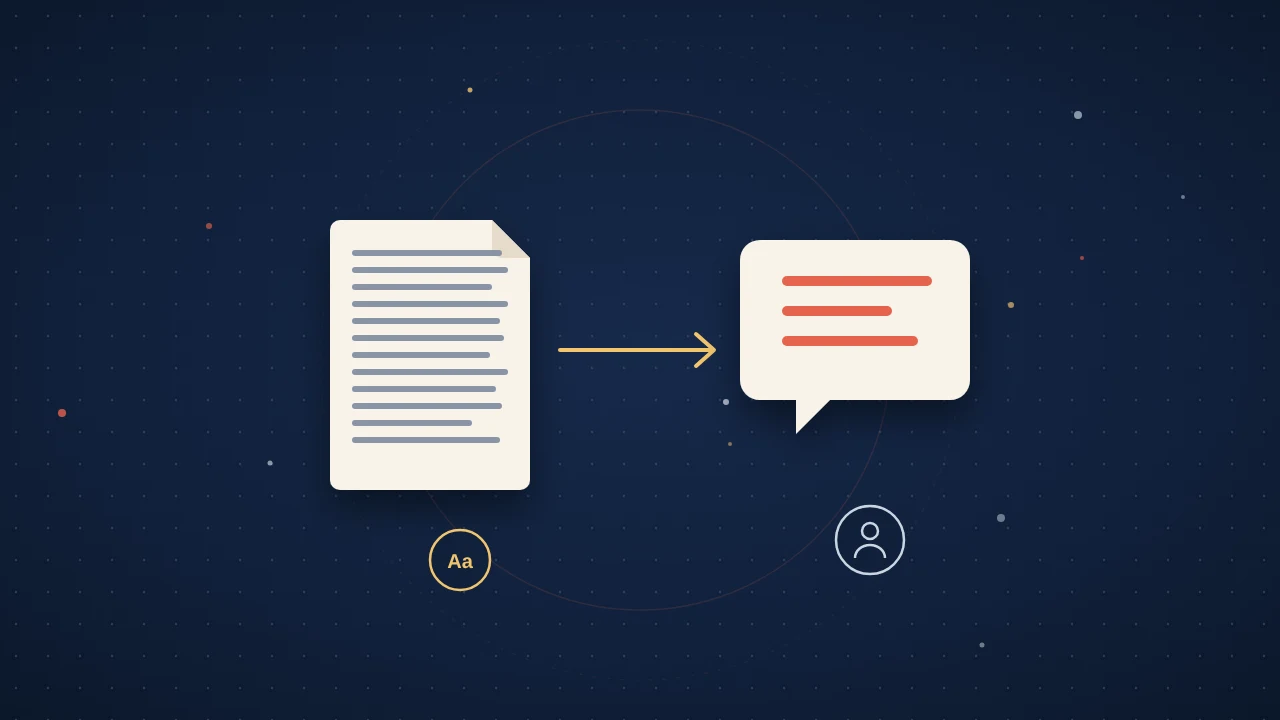
A plain language summary is a different piece of writing for a different reader. Here is how to write one from scratch, with an invented before and after example near the end.
Who It Is For
Not the specialists in your field. NIHR's guidance on plain English summaries names panel members and reviewers without specialist knowledge of your field, alongside members of the public, health professionals, policy makers and the media. Taylor & Francis lists practitioners, policy makers, the public and professionals in nearby disciplines.
That is a wide group, so write for one person in it: a curious reader from a different field with five minutes and no access to your paper.
The Questions It Answers
A plain language summary is not a shorter abstract: it answers a few questions in the order a reader would ask them. A tips sheet hosted by Taylor & Francis lists questions including why the study was done, what the researchers did and found, who took part, and what the results mean. For most papers, these five are enough:
- Why did we do this study?
- What did we do, and who took part?
- What did we find?
- What does it mean, and what does it not mean?
- What happens next?
On length, your journal or funder's limit comes first. At the time of writing (October 2026), Taylor & Francis asks for text summaries of 250 words or less.
How to Write It, Step by Step
Start from the questions, not the abstract
Answer each question out loud, as if a friend had asked, then write down what you said. Use "we". NIHR recommends active phrasing ("we will do it" rather than "it will be done by us") and short sentences.
Swap the jargon
NIHR advises avoiding jargon, abbreviations and technical terms wherever possible, and explaining any you have to keep. Cochrane's style manual gives small swaps such as "most" instead of "the majority of". A few more that come up in almost every paper:
- "participants" becomes "people who took part"
- "cohort" becomes "group"
- "longitudinal" becomes "we followed them for two weeks" (say how long)
- "statistically significant" becomes a plain statement of how big the difference was
- "efficacy" becomes "how well it worked"
Use numbers people can picture
The CDC Clear Communication Index score sheet asks three questions of any public material: does it use numbers the audience uses, does it explain what the numbers mean, and does it make the reader do calculations? It notes that whole numbers are used by most audiences, and its example compares a recommended portion of meat to the size of a deck of cards.
In practice, round to whole numbers, write "about 1 in 3" rather than "32.7%", turn effect sizes into something a reader can see ("about half an hour less sleep a night"), and do any subtraction yourself.
Leave things out
Cut the literature review, the names of statistical models, p-values, confidence intervals, secondary outcomes, acronyms and author contributions. Keep one honest limitation. The Taylor & Francis tips sheet asks for neutral language that stays as objective as possible, so no "breakthrough" and no claim the data cannot carry.
Test it with a non-specialist
Taylor & Francis suggests asking a non-specialist who is unfamiliar with the subject to read it: they should be able to understand the study, its conclusions and its potential impact. NIHR adds two more checks: use an online readability tool, and re-read your draft after a few hours with fresh eyes.
The quickest version: ask them to tell you what you found, in their own words. If that comes back wrong, fix the summary.
A Before and After Example
This example is invented, not a real study. Say you have a psychology paper on sleep and exam performance, and this is the abstract you would be tempted to paste in.
Before (abstract style, invented)
This longitudinal study examined the association between sleep duration and academic performance in a cohort of undergraduate students (N = 412). Participants wore actigraphy devices for 14 days preceding final examinations. Multilevel regression analyses indicated that shorter sleep duration was significantly associated with lower examination scores (b = 2.9, p < .01), controlling for prior GPA.
After (plain language, invented)
Do students who sleep less before exams get lower marks? We followed 412 university students for the two weeks before their final exams. Each wore a wristband that recorded when they slept. Students who slept less tended to get lower marks, even after we took their earlier grades into account. On average, each extra hour of sleep a night went with about 3 more marks out of 100. This shows a link, not proof that more sleep causes better marks. Next, we want to test whether helping students sleep more improves their results.
What changed: the question comes first, "actigraphy devices" became a wristband, the regression and the p-value went, the effect became marks out of 100, and one limitation stayed in. The after version is under 100 words, well inside a 250-word limit.
Once you have it, the same paragraph becomes your press pitch, launch post and lab page text. This 30-day plan for promoting your paper shows where each one goes.
Taking It Beyond Text
Some people you want to reach will never read a paragraph, however plain.
Amplify turns your paper into formats for them. Its audio brief and one-page infographic are generated from the PDF you upload and nothing else, with the title, the authors and a link back to the paper of record on every piece. The audio brief comes in English plus 21 more languages on request (22 in total, including Spanish, Mandarin, Hindi and Japanese), which matters if your work touches people who do not read English.
Each format arrives as three variants you can edit line by line. A person reviews every format before it is released, and nothing goes out until you approve the wording. Your own written summary is the yardstick: if the audio brief says something you would not say, change it.
Write It Before You Need It
Once you know the questions, it is a short job, and often the most reused paragraph your paper has. Write it before publication, test it on one person outside your field, and keep it next to the PDF.
Quick answers
Is a plain language summary just a shorter version of the abstract?
No, it is a different piece of writing for a different reader. Rather than trimming the abstract, it answers a few questions in the order a reader would ask them: why you did the study, what you did and who took part, what you found, what it does and does not mean, and what happens next.
How long should a plain language summary be?
Your journal or funder's limit comes first. At the time of writing (October 2026), Taylor & Francis asks for text summaries of 250 words or less. It can be much shorter: the guide's invented sleep study example comes in under 100 words and still covers the question, what was done, the finding, one limitation and the next step.
How do I explain statistics in a plain language summary?
Use whole numbers people can picture and do any calculations for the reader. Write "about 1 in 3" rather than "32.7%", turn effect sizes into something a reader can see, and replace "statistically significant" with a plain statement of how big the difference was. The CDC Clear Communication Index score sheet notes that whole numbers are used by most audiences.
How can I check that my plain language summary is easy to understand?
Ask a non-specialist to read it, then tell you what you found in their own words. Taylor & Francis suggests someone unfamiliar with the subject, who should be able to understand the study, its conclusions and its potential impact. NIHR adds two more checks: use an online readability tool, and re-read your draft after a few hours with fresh eyes.