Video Abstracts for Life Sciences Papers: Showing Methods Clearly
How to plan a video abstract for a methods-heavy biology paper: pick the audience first, show the workflow one step at a time, and clear the rights to your figures. It includes a shot plan for a two-minute video and the licensing points to check.
Your paper has a beautiful Figure 1: a workflow from tissue sample to sequencing to analysis, with six boxes and four arrows. In the paper it works because readers can stare at it. In a video, shown all at once for eight seconds, it is a wall.
Life sciences papers are often methods-heavy. The method is half the contribution, and other labs care about it as much as the result. A video abstract is a chance to show the method moving, one step at a time, which a static figure cannot do.
Pick the Audience Before the Script
A 2015 Cell Press guide to video abstracts frames the first decision as a choice of audience: peers in your field, the larger scientific community, or the general public. A public video, the guide notes, means investing in visual aids and simplifying the paper's language.
For a biology paper, the audiences tend to want different things from the same video:
| Audience | What they want to see | What to lead with |
|---|---|---|
| Researchers in your subfield | Exactly what you did differently, and whether they could reproduce it | The method step that is new |
| The wider life sciences community | Why the question matters and what the method makes possible | The problem, then the result |
| Clinicians or practitioners | What it means for their work, and what it does not yet mean | The result and its limits |
| Funders and your department | That the work answered the question it set out to | The question and the outcome |
Pick one row. A video that tries to serve all four ends up too technical for some and too thin for the others.
Show the Method One Step at a Time
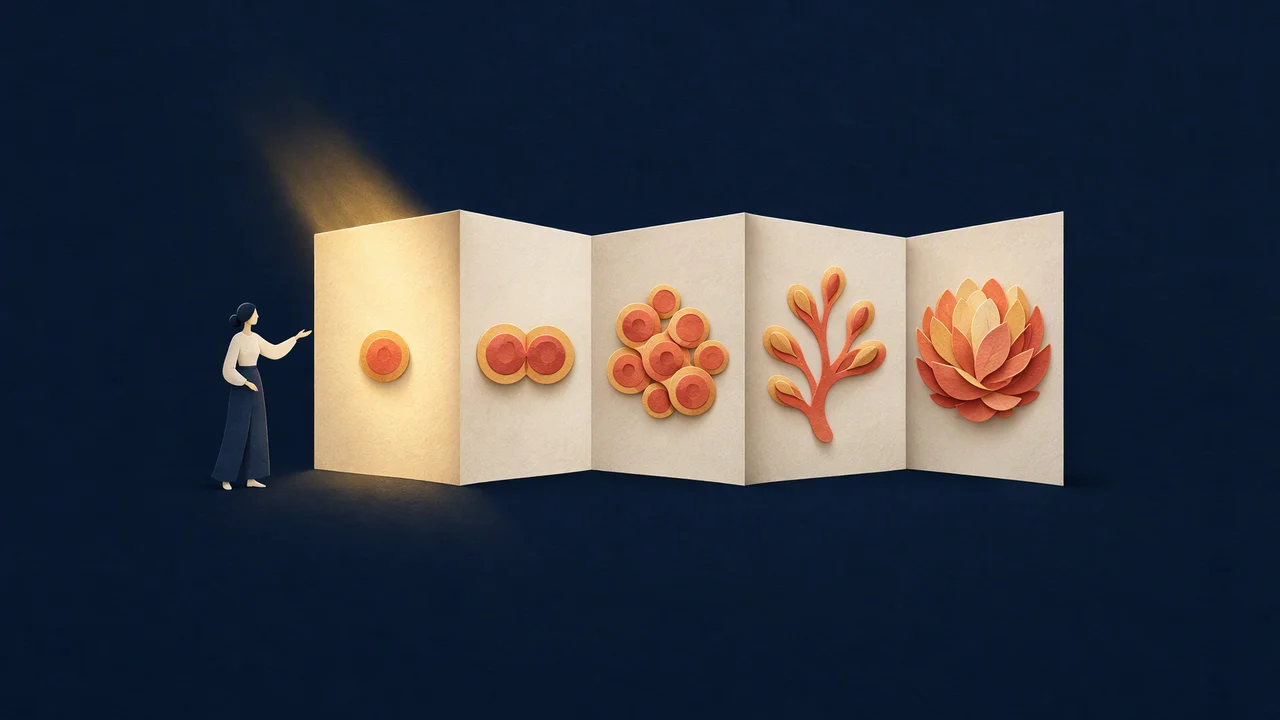
The fix for the six-box figure is to build it up. Start with the sample, add one box, explain it, add the next. By the end the viewer has seen the whole workflow, but never had to read it all at once.
A worked example: a two-minute shot plan
Say your paper describes a new protocol for growing intestinal organoids from small patient biopsies, and you are making the video for other labs. A plan might look like this:
| Time | On screen | Voiceover covers |
|---|---|---|
| 0:00 to 0:15 | Title, authors, journal | The problem: the starting material is small and hard to grow from |
| 0:15 to 0:45 | Workflow figure, built one step at a time | The three steps that differ from the usual protocol |
| 0:45 to 1:15 | Microscopy images or time-lapse from your own data | What success looks like at each stage |
| 1:15 to 1:40 | One results figure, with the key panel highlighted | The main result, in one sentence |
| 1:40 to 2:00 | Limits, then the paper link and DOI | What the work does not show yet, and where to read more |
This is a hypothetical plan, not a finding. The point is the shape: one problem, one method built in steps, one result, honest limits.
At the time of writing (October 2026), Taylor & Francis says 2 minutes 20 seconds or less is optimal for social media, so a two-minute plan leaves room. Journals set their own limits, so check your journal's specification before you write. For the general process, see how to make a video abstract, and for which journals take them, journals that accept video abstracts.
Clear the Rights to Your Figures
Methods videos lean on figures and images, so licensing matters more than usual. These are publisher policies at the time of writing (October 2026), so check the current page for your journal.
- Open access under CC BY. PLOS applies the CC BY license to what it publishes, which means anyone can copy, reuse or modify the content as long as the author and original source are properly cited. Credit the figure on screen.
- Your own figures in other journals. Elsevier's copyright page lists reusing "their own figures, tables and images from the article in their own new works" among authors' rights, including for subscription articles, though terms can differ for society-owned journals. If you are unsure whether a video counts, ask the journal.
- Images that are not yours. When PLOS publishes a manuscript, it asks for proof that third-party content is openly licensed or that the owner gave written permission, and Elsevier notes that further permission may be required for third-party content within an article. Apply the same standard to your video: a borrowed microscopy image or a diagram from a review needs its own check.
The Cell Press guide's author describes crediting every figure he used in his own video, and warns against using anything copyrighted (he was choosing music). Both are good habits for yours.
Make It Findable, Then Share It
The same guide suggests a title built on keywords rather than a teaser: its example is that "Cancer's Secret" is not as effective as a title naming the molecule and the disease. It also says videos have had the most success when featured by the author's institutional community, so send it to your lab, department, any society communications offices and your institution's press office. If a press release is planned, have the video finished so it can go out with it.
Where Amplify Fits
Amplify makes a video abstract (16:9, about 3 minutes) and a vertical short (9:16, 45 to 60 seconds) from the PDF you upload and nothing else, along with an audio brief and a one-page, print-ready infographic. Every artifact carries the title, the authors and a link back to the paper of record.
Each format arrives as three variants that you can edit line by line or regenerate, which is where you fix the wording of a method step. A person reviews every format before it is released, and nothing publishes until you approve it. Whether a journal will host it is the journal's call, so if you want to submit it, check the journal's specs and AI policy first and ask the editor if unsure.
A clear methods video does something the paper cannot: it lets another lab watch the steps before deciding to try them. Plan it around one audience, build the method slowly, and clear the figures before you hit record.
Quick answers
How long should a video abstract for a biology paper be?
At the time of writing (October 2026), Taylor & Francis says 2 minutes 20 seconds or less is optimal for social media. Journals set their own limits, so check your journal's video abstract specification before you plan the script. A two-minute plan with one problem, one method built in steps and one result leaves room under that figure.
Can I use figures from my published paper in a video abstract?
Usually, but check the license first. At the time of writing (October 2026), PLOS publishes under CC BY, so anyone can reuse the content with proper attribution, and Elsevier lists reusing your own figures in your own new works among the rights authors keep, even for subscription articles. Images that belong to someone else need their own check.
Who should a life sciences video abstract be made for?
Decide before you write anything: peers in your field, the wider scientific community, or the public. A 2015 Cell Press guide frames it as exactly that choice, and notes that a public video means more visual aids and simpler language. The audience decides how much jargon, how many figures and which result to lead with.